殳蕴钰教授谈在加纳开展可可豆系列研究 Yunyu Shu on Cocoa Field Research in Ghana
本文最初于 2026 年 2 月 11 日 发布于微信公众号 Impactful Research;2026 年 4 月 28 日 同步至本网站。
Originally published on the WeChat official account Impactful Research on 2026-02-11; mirrored to this website on 2026-04-28.
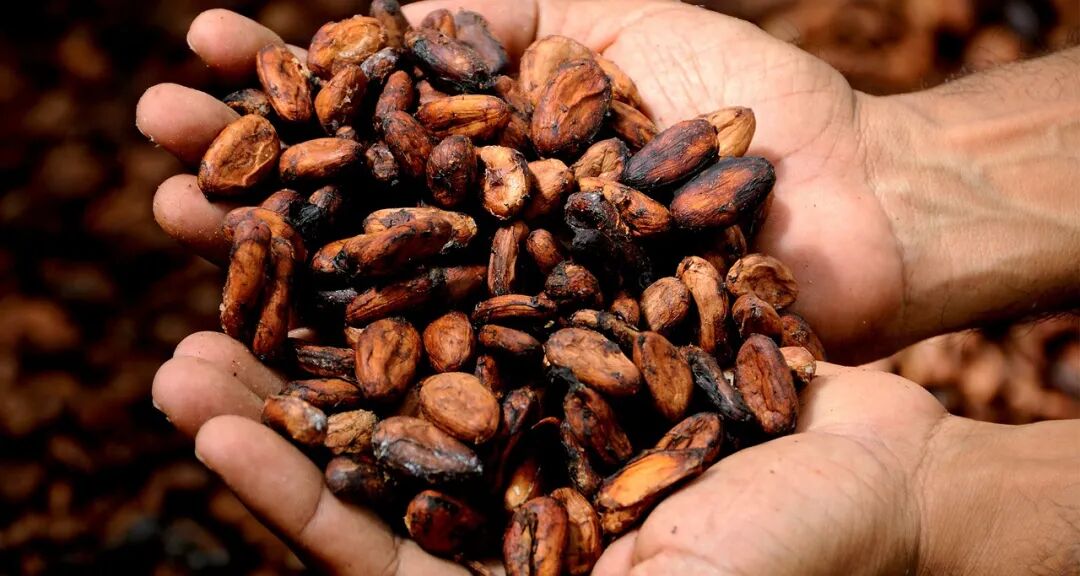
来源:Pixabay
Impactful Research 的读者朋友们,大家好!
过去一年里, “反内卷”成为中国经济领域的高频词。学术研究如何“反内卷”,也是我一直在思考的问题。从这一期开始,我们将采访一批勇于开拓学术蓝海的青年学者,期待通过他们开辟新方向、打造新议题的经历,为大家带来启发与力量。
值此新春之际,也祝各位读者在即将到来的马年里,在学术的疆场上策马扬鞭、奔赴理想,一往无前。新春快乐!
作为本系列的首篇推文,我们邀请到了上海财经大学经济学院的助理教授殳蕴钰,分享她在非洲开展田野实验的研究经历,并分享一些供年轻学者与博士生尝试实地研究参考的建议。殳蕴钰于2025年获得布朗大学经济学博士学位,研究方向为发展经济学与环境经济学,关注发展中国家微观主体的气候适应与绿色能源转型等议题,并在加纳、肯尼亚、乌干达等开展相关田野实验研究与合作。她的job market paper “Informed Climate Adaptation: Input and Output Subsidies for Shaded Cocoa” 聚焦加纳可可产业,探究政府的不同补贴政策与信息干预的交互作用如何推动农民采用绿色的气候适应行为。
本文正文内容约一万五千字,全文阅读需约40分钟
#本期访谈主要问题
1. 今天的采访不是针对某一篇文章,更多的是想分享你做研究的整个思路,以及怎么在不确定的环境下开辟出属于自己的领域。
2. 你当时在探索这篇和可可相关的研究时是否还有其他备选?如果有的话,你是如何权衡并最终决定探索非洲这条线路的?
3. 作为女性研究者远赴非洲开展田野调查,无疑需要极大的勇气。你当时是否曾有过顾虑或权衡过程?
4. 你到了非洲后是怎么开始开展研究的?
5. 如果当时没有巧合遇到这位热心的行政人员,你觉得研究会怎么开展?
6. 作为一个博士生,你在那能够开拓的时间也不长。在什么情况下你可能会放弃这个 idea?
7. 你在加纳的可可地里是如何通过观察与农民接触的?又是如何取得农民和官员的信任,从而让你能够持续开展更多研究的?
8.你从第一个idea 做到后面,是怎么把一个项目扩展成较多的系列研究的?
9.你现在在加纳的团队有多大?
10.所以实际上,在整体的规划上你是非常亲力亲为的?
11.对于那些想要尝试RCT的学者或是博士生,你是否可以给一些建议?
12.可能很多博士生最直接面临的是资金问题,你是否可以给点建议?
13.是不是有领导才能的人才更适合组织RCT?
Part 1: 做Field研究的整个思路
Q1:今天的采访不是针对某一篇文章,更多的是想分享你做研究的整个思路,以及怎么在不确定的环境下开辟出属于自己的领域。
Q1: Today’s interview isn’t about any specific paper; it’s more about sharing your overall research philosophy and how you’ve carved out your own niche in an uncertain environment.
对我来说可能是两块,有一定的契机,但核心还是源于研究兴趣。 去布朗之前,我就很确定自己想研究发展中国家的环境议题——这从博士阶段开始就一直在我脑海里。只是当时可能更多依托观测数据来开展相关研究。同时,我也会有意识地关注其他发展中国家环境问题的更广泛议题,比如通过新闻和媒体报道了解这些问题的现实进展。
For me, it was probably a combination of two things: there was a certain opportunity, but it was primarily driven by my research interests. Even before going to Brown, I was already certain that I wanted to work on environmental issues in the developing context—this had been in my mind since the beginning of my PhD. At that time, however, my work was more grounded in an observational-data approach. At the same time, I was also open to broader environmental topics in developing countries, for instance by following relevant news and media coverage, or reading The Economist.
契机的话我觉得应该是三点。
I think there were three key factors.
第一,博士就读初期,我导师跟我讲,你得提前思考一下作为一名来自中国的年轻研究者,你未来的学术标签到底是什么,属于你自己的个人标识是什么,如何在现在非常竞争的学术环境下去思考你的独特性。 他当时确实给了我一定的启发:他觉得很多来自中国的学生技术功底很强,能做很扎实的研究,但有时或多或少会更谨慎一些,不太敢从零开始去“闯”新的想法。比如当时(大概5年前),国内学者(包括博士生)中做非中国议题的并不多,而从零开始自己收集数据,做随机对照试验(RCT)的更少。他鼓励我,既然我当时还没有完全确定研究方向或求职论文要做什么,不妨尝试走出去看看。好的、兼具创新性和普适性的研究问题,往往来自对现实生活的敏锐捕捉;多国调研、观察与比较本身也有助于在学术上讨论一个问题的普适性。 因此,我当时开始尝试提出一些非中国语境的想法。虽然研究方案很不完善,但至少让我带着对问题的好奇,开启了他国调研的旅程。
First, early in my PhD, my advisor told me that as a junior researcher from China, I should think ahead about what my academic “brand” would be—what my own unique name tag would be, and how to define my uniqueness in such an increasingly competitive academic market. He did give me some inspiration at the time. He found that many students from China are technically very strong and can do solid research, but sometimes they can be a bit cautious—less willing to “venture out” and try fresh new ideas from scratch. At that time (about five years ago) , there were relatively few Chinese scholars (including PhD students) working on non-China contexts, and even fewer who did primary data collection or ran RCTs (randomized controlled trials). He encouraged me that since I hadn’t fully determined my research direction or my job market paper yet, I could try going out and exploring. Great research questions that are both innovative and broadly relevant often come from real life, and cross-country field exposure can also help when arguing for the generalizability of a research question. So I began proposing some non-China ideas. Although the designs were still rough, they at least gave me the curiosity to start field exposure beyond China.
第二是受到我很多布朗同学的影响。 我的博士一、二年级是疫情期间,因此 Development Tea 也变成了线上。它有点像国内的组会,是发展经济学同领域师生交流新研究想法、讨论进展瓶颈的地方。当时每周的Zoom会议几乎成了一个“联合国”(笑):师兄师姐各自讨论在不同国家的调研进展。有一位师姐是在学校里做实验,跟我们分享如何在封校之前有惊无险地抢回最后一组数据。还有一个同学去了莫桑比克做一个关于跨群体讨论如何帮助族群融合的课题,他所在的地方甚至还有战乱。当时我有一种被“打鸡血”的感觉,觉得可以开始进行这种尝试。
Second, I was influenced by many of my classmates at Brown. My first and second years of the PhD were during the COVID-19 pandemic, so our Development Tea—like a research group seminar where people share ideas and discuss research bottlenecks—moved online. Those weekly Zoom meetings turned into a kind of “United Nations meeting”: senior students were sharing field progress across different countries. One senior classmate talked about how she managed to complete an endline survey right before the campus lockdown. Another classmate went to Mozambique to work on a project about how intergroup discussions can foster ethnic integration; the area he was in even had ongoing conflict. I felt incredibly inspired by this and felt I could start attempting similar research myself.
第三个契机是 2022 年前后,美国有一系列关于巧克力的报道,以及我和生态学专业朋友的一些闲聊。 无论是玛氏还是雀巢,都开始推行所谓的“可持续可可”(sustainable cocoa)。因为我很喜欢吃巧克力,自然也会被一些类似“气候变化正在吞噬全球巧克力”、“到 2050 年全球可可供应可能下降三分之一”之类的媒体标题吸引,于是开始检索这背后潜在的环境切入点。我发现他们之所以推行这些,一方面是气候变化在媒体关注下非常热门,另一方面巧克力产业确实会受到气候变化的影响。偶然和生态学朋友聊天,她提到“荫蔽种植”可能是一种自然解决之道(nature-based solution)。做了一些调研后,我们发现科特迪瓦 (Côte d’Ivoire) 和加纳(Ghana)是世界两大可可生产国:科特迪瓦很早就进行了市场自由化,相关文献也比较多;而加纳在这一主题上还没有太多人涉足。所以我决定和小伙伴(也是我后来的长期合作者)一起利用博士三年级暑期去加纳看看“可持续可可”,以及在推行过程中可能面临哪些挑战。
The third opportunity arose in 2022, when a series of reports in the US about chocolate coincided with conversations I had with friends in ecology. Both Mars and Nestlé began promoting what they called “sustainable cocoa.” Since I love chocolate, I was naturally drawn to headlines such as “Climate change is threatening cocoa globally” or “Global cocoa supply may decline by one-third by 2050” and I started looking into the environmental angles behind these narratives. In a casual conversation, a friend in ecology mentioned “shade-grown practices” as a possible nature-based solution. I found that chocolate companies were promoting this because climate change was a very hot topic in the media, and chocolate is significantly affected by climate change. After some initial research, I found that Côte d’Ivoire and Ghana are the world’s two largest cocoa-producing countries. Côte d’Ivoire liberalized its market early and has a relatively larger literature, while Ghana had received less attention on this topic. Therefore, I decided to use the summer break of my third year—together with a collaborator who later became my long-term coauthor—to go to Ghana and investigate sustainable cocoa and the challenges involved in its implementation.
我当时带着两个疑问:第一,可可受到气候变化的影响是否真的这么大?第二,他们提到的“可持续适应性技术”(如遮荫种植)在加纳当地的认知是什么样的,是农户不了解,还是执行过程中存在怎样的障碍?这两点对它是否能成为一个可行的研究课题非常重要。 最开始我主要是带着这个角度去的加纳,后来在实地调查中发现了各种各样的有趣事实,才促成了我的第一篇基于田野调查的研究,也就是我后来的求职市场论文。
I had two questions at the time: First, is cocoa really affected so significantly by climate change shocks? Second, what is the perception of their “sustainable cocoa” (shade-grown cocoa) among local people in Ghana? Do farmers not know about it, or are there any frictions in the implementation process? These two points were crucial in determining whether it could become a valid research question. Initially, I approached it primarily from this perspective, but later, I discovered various facts in the field, which ultimately led to this becoming my first field-based project, that is my job market paper.
Q2:你当时在探索这篇和可可相关的研究时是否还有其他备选?如果有的话,你是如何权衡并最终决定探索非洲这条线路的?
Q2: Back when you were exploring this study on cocoa, did you have any alternative candidates in mind? If so, how did you weigh the pros and cons, and what ultimately led you to focus on the African trajectory?
我觉得当时反反复复考虑非常多次。最开始因为需要资金去非洲调研,所以当时看到PEDL Call For Proposals时,我跟合作者逼自己在一周内写了一个研究计划,但那个研究计划跟我现在求职论文呈现的样子截然不同。(我们)当时的想法是,美国、欧洲等发达国家的巧克力市场已经存在针对绿色偏好(green taste)的绿色溢价(green premium),这是存在于产品终端的。既然终端消费者愿意支付溢价,那这部分溢价在多大程度上能到达生产端的农户手中?所以我们最开始提交给PEDL项目资助方的研究问题是从可可产业链的视角来看绿色偏好是如何沿供应链传播(Propagation of Taste for Climate Resilience: Evidence from Cocoa Supply Chain)。 说实话,当时我们更关心的是农业市场的产业组织(IO)问题,想看在供应链中存在怎样的摩擦,是否这部分溢价因为被中间商吃掉了,而农民是否并不知道国际市场的价格,才导致他们没有进行相应的调整。
There was a lot of back and forth at the time. Initially, I needed some funding to support my field visits in Africa. When we saw the PEDL’s open call for proposals, we pushed ourselves to put together a grant application within a week, but that proposal was completely different from what my current Job Market Paper eventually became. The initial motivation was that in developed countries like the US and Europe, there is already a “green premium” in chocolate and cocoa products, reflecting green consumers’ preference for environmentally friendly products. This premium existed at the consumer end. Since end consumers were willing to pay a premium, to what extent did this premium reach the farmers at the production end? So the research question we first proposed to PEDL was: How does the green taste propagate through the cocoa supply chain(Propagation of Taste for Climate Resilience: Evidence from the Cocoa Supply Chain)? To be honest, I was more interested in the Industrial Organization (IO) issues of the agricultural market at the time, wanting to see what kind of friction existed in the supply chain, and whether this premium was captured by middlemen, preventing farmers from knowing the international market prices and thus preventing them from making corresponding production adjustments.
去到加纳以后发现(我们的初步设想)彻底推翻了。加纳可可部(相当于中国农业部的政府机构)制定了“保险价格”,在每年的可可生长季之前就把这个价格公开了,所以一开始价格溢价激励的视角就被阻断了;然后我们当时就说,既然这件事情加纳政府有这么大的决策权,另一个角度他们在政策制定的空间上也会有更多的自主权,所以我们就把研究问题转换到地方政策制定的角度,思考(加纳)有怎样的政策需要,比较不同政策设计的需求。 这是我们到了加纳之后才做出的重大改变,最开始是没有想到的。
Upon arriving in Ghana, we discovered that our initial assumptions were completely wrong. The Ghana Cocoa Board (i.e., COCOBOD, a government agency equivalent to China’s Ministry of Agriculture) sets the producer price (functioned like insurance price), which is announced before the start of each cocoa growing season. Therefore, our initial perspective of using price premiums as a market-based incentive was immediately rendered irrelevant. We then realized that since the COCOBOD had such significant decision-making power in price setting for cocoa beans, they would also have more autonomy in policy design and implementation.So, we shifted our research focus to the perspective of local policymaking, considering what policy needs that Ghana had and comparing the implementation requirements and effectiveness of different policy designs. This was a major change we made only after arriving in Ghana, something we hadn’t anticipated initially.
Q3: 作为女性研究者远赴非洲开展田野调查,无疑需要极大的勇气。你当时是否曾有过顾虑或权衡过程?
Q3: Undertaking fieldwork in Africa poses unique challenges for female researchers. Did you go through a process of weighing the risks before committing to this path?
我觉得自己这个过程其实比较少。首先,我当时是跟同伴一块去的,所以虽然当时不认识其他人,但至少有可以相互照应的求救机制。第二,学校会有很多国际医疗服务支持。我们在去非洲前就要做各种行前评估、打各种疫苗;此外,学校也提供远程国际医疗服务,确保在非洲也可以找到国际医院或者24小时线上医疗支持。第三,我第一次去大多数时间待在首都阿克拉(Accra),城里条件会相对好一些,当地讲英语,这一点也非常关键。
I think my experience was relatively smooth. First, I went with my coauthor, so even though I didn’t know any local people there, I had someone to rely on in case of an emergency. Second, the university offers many international medical services. Before travelling to Africa, we had to complete pre-travel consultations and get various vaccinations. They also provide international medical assistance, so we could locate international hospitals on the ground or access 24/7 remote medical support. Third, on my first trip I spent most of my time in Accra, the capital, where conditions are generally better and English is widely spoken—both were very important.
Part 2: 从非洲的可可地开始
Q4:你到了非洲后是怎么开始开展研究的?
Q4:How did you begin conducting your research after you arrived in Africa?
每个研究的开展都有不同的契机,我可以从第一个关于可可的研究开始讲。
Every research project has a different starting point, and I can begin by talking about the first study on cocoa.
当时我已经了解到加纳的可可是由政府管辖的,要开展合作就绕不开与政府部门打交道。当时我还没开始收数据,只是想参观一下可可农田,所以我在领英上找了加纳可可局一些相对初级的工作人员发私信。有一位男生回复了我,表示欢迎,但提到如果我要去,需要写一封由导师共同署名的介绍信,说明身份和访问目的,递交给加纳可可局的总部。我抱着试一试的心态,自己草拟了一份信请导师签名,然后放了一个布朗大学的标志。
At that time, I understood that the whole cocoa industry in Ghana was under the lead of COCOBOD, and any collaboration would inevitably require government support. Since I wasn’t yet involved in any data collection and simply wanted to visit cocoa farms, I contacted some relatively junior staff members at the Ghana Cocoa Board via LinkedIn. One guy replied, welcoming me, but mentioned that if I wanted to visit, I would need to write an introduction letter co-signed by my advisor, explaining my identity and purpose of visit, and submit it to the Ghana Cocoa Board head office. I decided to give it a try, drafted a letter myself, with my advisor’s signature.
在加纳期间我平时会在纽约大学阿克拉研究中心(NYU Accra Research Center)蹭网自习,跟里面的行政人员闲聊时偶然知道他的家人在加纳可可部工作,她非常热心地主动提出帮助我去联系,并且直接手把手教我改了那份介绍信的抬头(我最开始没有太多的远见,只想去参观可可农场,所以就只写了可可部下跟农民直接接触的农技培训部(Cocoa Health and Extension Division, CHED)。她预见到如果我要后续拜访农民并进行访谈和实验,或者需要申请相关数据,还会需要研究部门支持;万一之后想做关于当地采购公司涉及交易买卖的研究,就需要质检部门以及出口部门,所以她帮我把抬头直接改成写给加纳可可部部长,同时抄送给下面所有的部门。在她及家人的鼎力帮助下,这封信最后直接递交给了可可部部长,花了大约 20 天时间才拿到其最高首领批复。正因为这样写,后续扩展、拿数据、及跨部门寻求支持时,不需要再重新提交介绍信。这封介绍信持续用到了现在,为我后面系列研究计划中其他的拓展问题打下了比较好的基础。
While I was in Ghana, I often studied at the research center of NYU Accra for reliable Wi-Fi. One day, I was chatting with one of the administrative staff, and she mentioned that someone in her family worked at COCOBOD. She immediately offered to help me reach out, and she also helped me revise who I was addressing the letter to. At first, I had addressed the letter only to CHED—the Cocoa Health and Extension Division—because I was simply hoping to visit a few cocoa farms and didn’t think much beyond that. She pointed out that if the project evolved—if I wanted to interview farmers, run experiments, or request administrative data—I would likely need the research unit involved. And if I ever shifted toward ideas on local buying companies (middlemen) involved in trading, I would need to contact the quality control and cocoa bean export departments. She suggested a more future-proof approach: address the letter to COCOBOD’s Chief Executive directly and copy all relevant departments. With her help (and her family’s support), the letter made it to the Chief Executive’s office. It still took about twenty days to receive formal approval, but it was worth it. Because the letter was cleared at the top and copied broadly, I didn’t have to start over each time I later expanded the project, requested data, or sought cross-departmental support. I’ve been using that same introduction letter ever since, and it ended up laying a good foundation for other extensive research questions in my subsequent pipeline.
这里还涉及到另一件趣事。我的一个学姐跟我说,加纳当地人比较传统,特别是见政府官员时,递纸质名片会显得更正式一些,所以我和小伙伴那晚临时用PPT自制了一张名片,各自印了100张,到现在还剩了不到50张(笑)。
There’s another interesting anecdote related to this. My senior classmate taught me that: people in Ghana are kind of old-fashioned—especially when you meet government officials—and that handing over a physical business card is seen as more formal. Following her suggestion, my coauthor and I quickly made our own business cards in PowerPoint and printed 100 copies each. We still have about 50 left (laughs).
如果说合作的开始多少有幸运的成分,那么能保持长期、持续的合作,更得益于我们每次和当地政府沟通时,更多扮演的是一个认真倾听者的角色。 虽然我们是带着研究问题去的,但跟政府交流时,我们不是一股脑地去说我们想做什么样的研究问题,而是去倾听他们的诉求和政策执行中的实际挑战。虽说有一定的学术包装的成分,但结合他们的政策诉求、以更加通俗的语言来阐述我们的研究问题,这样会比较容易推进,他们也愿意听。后续我们也会及时跟进、定期向他们汇报研究进展,这也有助于政府支持的持续和深入。
If the start of the collaboration involved some luck, its continuity really came from how we engaged with local officials. In each conversation, we tried to play the role of careful listeners. Even though we came with research questions, we didn’t go in and immediately pitch what we wanted to study. Instead, we first asked about their priorities and the practical challenges they face in policy implementation. Of course, there is an academic framing component, but we tried to connect our questions to their policy needs using their policy language. This made it easier to move forward, and they were more willing to engage. We also made a point of following up and sharing updates on our progress, which helped sustain and deepen the government’s support and engagement over time.
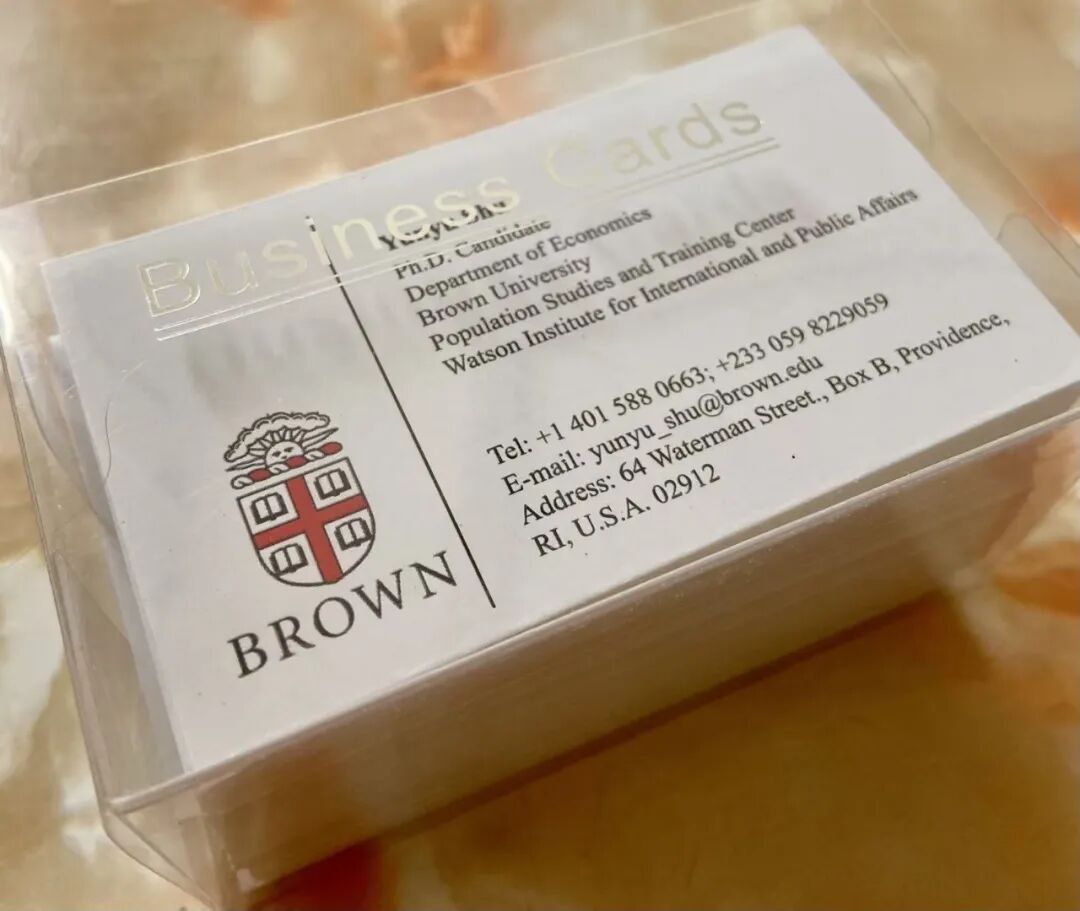
临时用PPT自制的名片(图|殳蕴钰)
DIY business cards (made in PowerPoint). Photo credit: Yunyu Shu
Q5:如果当时没有巧合遇到这位热心的行政人员,你觉得研究会怎么开展?
Q5: If you hadn’t crossed paths with that supportive administrator by chance, how do you think the study would have unfolded?
我觉得会是两步。(介绍信)当时我确实本身就不抱太大希望,我可能会做的第二件事情是看一些加纳的政策报告,或者看相关研究者是怎么做的。一般情况下,去看文章或工作论文的致谢(尤其是RCT的文章),都会写明是跟哪个机构合作,你去找到这个作者,让他帮你引荐给这个合作机构还是有可能的。第二个是当时我有去加纳大学找他们的博士生或学者。加纳可可局对于他们本地来说很重要,所以农学院等一定有人在讨论相关的话题(我后来也确实跟其中的一两个人聊过)。所以我觉得步伐可能会相对慢一点,但最终还是能够解决的。
I think it would be a two-step process. (Introduction letter) At the time, I honestly didn’t have high hopes. The second thing I might do is look through policy reports from Ghana or see what researchers in the same field are doing. Generally, when you look at the acknowledgments section of articles or working papers (especially RCT papers), they will mention the implementation partners they collaborated with. You can try to reach out to authors and ask if they could connect you to those partners; that’s a possibility. I also went to the University of Ghana to talk to faculty and PhD students. COCOBOD is highly relevant locally, so there are definitely people in the agriculture and other departments working on related topics (and I did end up speaking with one or two of them). Overall, I expect the process might be a bit slow, but it would eventually work out.
Q6:作为一个博士生,你在那能够开拓的时间也不长。在什么情况下你可能会放弃这个 idea?
Q6:Given the limited timeframe of a PhD field visit, under what circumstances would you have considered abandoning this idea?
是的,我当时也是因为进展比较顺利,才完全转移了研究重心,这种机会是可遇不可求的。当时我读博士三年级,有足够的时间更换研究角度,对我来说时间成本还可以接受,因为大不了浪费两三个月的时间,而这段时间完全用来测试一件事情的可能性,我觉得未尝不是好事。我当时是整个暑假都待在那边,我觉得既然我已经在加纳了,就不想白费时间,尽可能尝试各种主题。我当时还探索性地了解过加纳的其他背景,比如金矿开采,甚至去过加纳商会了解中国企业出海。
Yes, I totally shifted my research focus because things were progressing smoothly at the time. This kind of opportunity is hard to come by. I was in my third year, so I still had some time to change my research direction if it failed. The time cost was acceptable to me, because at most I would waste two or three months. It was worth spending a few months focusing on one idea and explore its potential. I spent the entire summer in Ghana, and since I was already there, I didn’t want to waste the chance. I tried to explore as many topics as I could. I also looked into other parts of Ghana’s context, for example, gold mining or Chinese firms operating overseas.
做实验需要“天时地利人和”。 不能说其他的那些项目已经放弃了,只是当下既然政府这边给的帮助比较及时,我也申请到了经费,就先把这件事情做了。
**Doing fieldwork really depends on having the right timing, setting, and support in place. **I’m not saying I’ve given up on my other ideas—it’s just that, given the timely support from the government and the funding I was able to secure, I decided to prioritize this project first.
Q7:你在加纳的可可地里是如何通过观察与农民接触的?又是如何取得农民和官员的信任,从而让你能够持续开展更多研究的?
Q7:How did you conduct observations and interact with farmers in the cocoa fields of Ghana? And how did you gain the trust of farmers and officials, enabling you to continue conducting further research?
我们先去走访了几个村庄。我其实从来没有下过田,当时下雨下得非常厉害,我穿了雨鞋,走得深一脚浅一脚,还摔在里面,特别搞笑。我们去了三个村庄,准备了一些访谈的问题,对这些农民开展了小组访谈(focus group)。我觉得还是有一些记忆非常深刻的瞬间。第一个村庄的访谈你肯定问得最仔细,对背景就有了最充足的了解。因为雨下得很大,到第三个村庄的时候其实我们已经没有那么想去了,你了解到的新的信息也没有那么多,可可地你也看到了。但是当时那位带我们去的政府官员说农民其实很早就开始等着你们了。我们也发现,他们虽然很穷,过来参加这个访谈也完全是无偿的,还要走很多的路走过来,但每个人都是盛装出席,穿得非常像每周日要去教堂一样。我们在那一瞬间就觉得唯有认真对待才可回应他们的真诚。所以最开始,我觉得是因为这种真诚以及相互的认真对待,使得他们相信我们真的会给他们带来一些变化,哪怕很微小。 他们也提到,之前会有很多国际公司什么的在这里,每次都说“我们会再回来”,但从来都没有再回来过。我们在2022年7月去做了第一次访谈,然后2022年10月回过去做试点(Pilot),真正的研究可能是2023年2月。我们在第二次回去的时候,这些农民对我们的信任可能是大幅提升的,因为他们觉得我们说出的话会比较可信,是真的有说到做到。
We first visited a few villages and did some focus groups. I had never been out in the fields before, and it was pouring that day. I had on rain boots, but I was still slipping and stumbling through the mud—and I even fell at one point, which was honestly pretty funny. We visited three villages in total. We came with a set of questions and ran focus group discussions with farmers. There are a few moments from those visits that really stayed with me. The first village was where we asked the most detailed questions, and it gave us the strongest grounding in the local context. By the time we got to the third village, the rain had been so relentless that we were honestly less eager to go. We also felt we had already seen the cocoa farms and weren’t learning that much new. But the government officer traveling with us said, “The farmers have been waiting for you for a long time.” When we arrived, we were struck by how they showed up. Many of them were very poor, and the discussion was entirely unpaid. Some walked a long distance just to be there. Yet everyone came dressed in their best clothes—almost as if they were going to church on Sunday. In that moment, we felt we owed them the same seriousness in return.** I think it was this sincerity and mutual respect that made them believe we would truly bring something meaningful, even if the change would be small. **They also told us that many international organizations and companies had visited before, and each time they said, “We’ll come back,” but they never did. We did our first round of interviews in July 2022, returned in October 2022 for a pilot, and the main study began around February 2023. When we went back the second time, the farmers’ trust in us had increased significantly because they believed in what we said was credible and that we were actually doing what we promised.
第二点我想是因为他们真的见到了我本人,这个点上可能小团队也有小团队的好处。 如果是比较大的团队,他们想要去表达某些诉求的时候,见到的不过是这件事情的实施者,而不是真正主导的人。
Second, I think it also helped that they met me in person, and this is where a small team can have an advantage. In a larger project team, when people want to raise concerns or share their needs, they often end up speaking only with the field staff or day-to-day implementers, rather than the person leading the project.
另一方面,我们也会尽我们所能提供一些帮助。 加纳人总体来说是非常勤劳和刻苦的,尤其是在政府部门工作的这些年轻人,他们是愿意去接触和了解一些新东西的。所以当你去跟他们讲,甚至是一些很简单的Excel的工作,他们也都很重视和珍惜。我们当时有一个部门的负责人,他是有想之后读公共政策方面的博士项目的,所以我们可能会有的没的跟他聊一些。这些东西其实非研究相关,但也能够帮助你们像朋友一样相处,也为了后面更好的相互学习跟服务。
On top of that, we tried our best to be helpful whenever we could. People in Ghana are generally very hardworking, and many of the younger staff in government offices are genuinely open to learning new things. So even when we shared something as simple as an Excel workflow, they took it seriously and really appreciated it. At one point, a department head told us he was considering applying for a PhD in public policy, so we would chat with him about all sorts of things. None of that was directly about the research, but it helped us relate to each other more like friends,and it made the relationship more collaborative, which supported mutual learning and cooperation over time.
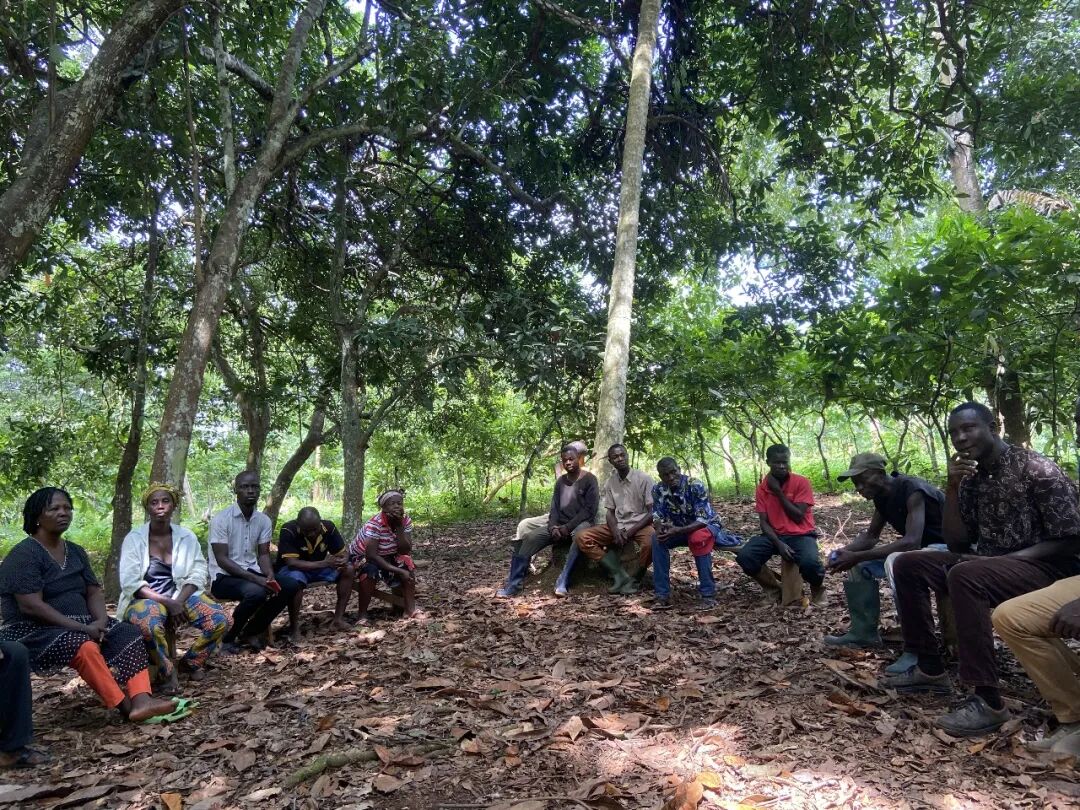
可可地里的访谈(图|殳蕴钰)
Focus group interviews in the cocoa field. Photo credit: Yunyu Shu
Q8:你从第一个idea 做到后面,是怎么把一个项目扩展成较多的系列研究的?
Q8:How did you expand your initial idea into a project with multiple pipelines?
这要回到我的第一个研究计划。虽然从目前看来,还没有任何一篇文章是在做可可的绿色偏好是如何在其供应链中传导,以及这种传导如何体现在对气候变化的应对,但事实上我现在的研究框架是围绕这个展开的。 可以说,我是在把可可产业链的各个环节拆开来做:围绕不同环节的机制与约束,分别展开相应的研究。后续更多的研究问题延伸,则主要来自之前项目尚未完全回答的问题,或者在田野调查或数据中的一些额外发现。
This goes back to my very first proposal. While there still isn’t a single paper that directly studies how green taste propagates through the cocoa supply chain, my current research agenda has essentially traced back to this initial idea. In other words, I’ve been unpacking the cocoa value chain and studying different sectors one by one, with each project focusing on one or two specific mechanisms. Many of my follow-up questions come directly from what earlier work leaves unanswered, or from new patterns and surprises that emerged as we moved from one stage of the research to the next.
我们的第一篇文章关注的是:在生产端,直接与农民接触的政府部门如何通过设定不同的政策组合(policy bundle),帮助农民提高气候韧性(climate resilience),探讨在生产端可以有怎样的气候适应策略(climate adaptation strategy)。 在这项研究(Shu and Zhang 2025)中,我们集中讨论不同补贴政策与信息干预的交互作用,如何推动农民采用绿色的气候适应行为;同时也指出,不同补贴政策的有效性在很大程度上取决于政策目标人群对相关收益与风险的正确认知信念。我们所关注的适应策略是荫蔽种植(shade-grown technology),即在可可农田中间种高大的林木。
Our first paper looks at the production side: how to design the different policy bundles to improve the farmers’ adoption of climate adaptation strategy to build on climate resilience. In Shu and Zhang (2025), we focus on how different subsidy schemes interact with information nudges to encourage the adoption of “green” adaptation behaviors. We also show that the effectiveness of these subsidies depends heavily on whether the target population holds accurate beliefs about the relevant benefits and risks. The adaptation strategy we study is shade-grown practice, that is, intercropping cocoa with tall timber trees.
在我们汇报论文的过程中,也出现了一些拓展性的讨论:生态学家或其他领域的学者更关心这些林木能够固碳多少——也就是它在气候减缓(climate mitigation)方面的作用。我们非常认可这类讨论,并因此发展了第一个拓展方向。因为荫蔽种植同时具有气候减缓和气候适应两重属性:一方面,它通过固碳(carbon sequestration)带来社会福利;另一方面,它也可能通过稳定产量等渠道给农民带来个人收益。我们因此想进一步探究:农民在理解这两类收益时,信息摩擦主要来自哪一块?关于“社会福利”的信息是否会提供额外激励? 在第一篇论文的基础上,我们设计了一种纯信息干预方案,分别突出同一适应策略的社会效益属性与私人效益属性,并检验受试者的反应差异以及“更多引导”是否总是更好的。
When we presented the paper, it naturally led to broader discussions. Scholars in ecology and related fields were especially interested in how much carbon these trees can sequester—that is, the climate mitigation side. We took that perspective seriously, and it motivated our first extension. Because shade trees have both mitigation and adaptation functions, they generate social benefits through carbon sequestration while also potentially delivering private benefits to farmers, such as more stable yields. This raised a new question: where do the key information frictions lie—on the social-benefit side or the private-benefit side? And does information about the social benefits provide additional motivation? Building on the first paper, we designed a pure information treatment that separately emphasizes the social-benefit attribute versus the private-benefit attribute of the same adaptation strategy, and we examine how responses differ and whether “more nudging” is always better.
后续我们又把研究从生产端延伸到产后与交易环节。 加纳农民在可可丰收后,还有很大一部分工作是对可可豆进行发酵和烘干;烘干后需要联系中间商运送并转卖,最终获得收入。我们认为,相比单看生产端,产后(post-production)同样是非常关键的环节。因此沿着这个思路,我们近期的研究又做了两块延伸:第一,将重心从生产端转向产后端,观察农民在储存和烘干环节如何受到气候冲击(climate shocks)的影响,以及这些环节对农民气候韧性究竟是“放大器”(multiplier)还是“缓冲器”(mitigator)。第二,更深入地探讨农民与当地采购公司的交易员之间的交易过程,这也更接近我们最初关注的“中间商角色”的问题。
We then extended our work beyond production to post-production activities and trading. After harvest, farmers spend substantial time fermenting and drying cocoa beans, and once the beans are dried, they rely on purchasing clerks to transport and sell their beans. We view this post-production stage as a critical part of the value chain. Following this logic, our recent work has two additional extensions. First, we shift the focus from production to post-production—storage and drying—to study how these stages are affected by climate shocks, and whether they act as a multiplier or a mitigator for farmers’ climate resilience. Second, we take a closer look at the transaction process between farmers and local buying companies, which brings us back to our original interest in the role of middlemen.
在实地收集数据时我们发现,农民在与中间商交易时会记录非常详细的交易信息,包括交易的具体日期、交易对象和数量。这是一套连加纳政府可可部门都没有的高频交易记录,我们也花了很长时间把这部分信息逐条数字化。这份独特数据不仅让我们能够刻画年产量,还能用来识别农民在应对气候冲击时的交易动态:他们是“即收即卖”的碎片化交易,还是囤积后集中出售以降低运输成本、并争取更高价格?从这个角度看,这些高频数据使我们得以观察气候冲击如何改变可可交易的频率与时点,以及农民在面对不同冲击时如何与中间商互动,从而更完整地讲述产后(post-production)的故事。
During fieldwork, we found that farmers often keep detailed transaction records when they trade with intermediaries—dates, counterparties, and quantities. This creates a unique high-frequency dataset that even COCOBOD itself does not have. It allows us not only to measure annual production, but also to capture farmers’ trading dynamics: whether farmers engage in fragmented “sell-as-you-harvest” transactions or whether they store and sell in bulk—potentially to seek better terms and reduce transport costs. These data let us examine how climate shocks change the timing and frequency of cocoa transactions, and how farmers interact with intermediaries under different shocks—helping us capture a more comprehensive post-production story.
这一系列研究目前仍处在新数据收集或分析阶段,但整体框架是环环相扣、层层递进的。
This broader research agenda is still in the stage of extensive data collection and analysis, but all projects are closely connected and designed to build on one another.
Q9:你现在在加纳的团队有多大?
Q9:How large is your team in Ghana right now?
我们是在当地找了一个帮助做调查的公司,并且已经跟他们合作大概三四年了。公司里面的每一个访谈员我都非常熟悉,包括他们的脾气秉性、擅长什么事等。我们现在每次项目通常会安排10到16名调查员,为了保障项目的进行,可能会分配1到2名组长。调查员每天的工作量大约是访谈5-6位受访对象,组长的访谈量通常是1到2位受访对象,但他们需要承担更多的协调工作。在西非,除了行政领导,村民也倾向于听取“chief farmer”或老者的意见。因此,组长需要提前和村长或村里的酋长沟通;此外,队长还需负责执行行动计划,这个行动计划是调研前我和组长共同根据地图规划出的从交通和可行性角度出发的最优路径。
We hired a local company to assist with the surveys, and we’ve been working with them for about three or four years. I’m very familiar with each enumerator in the company, including their personalities and strengths. For each project, we typically assign 10 to 16 enumerators, and to ensure the project runs smoothly, we may assign one or two team leaders. Each enumerator interviews approximately 5 to 6 farmers per day, while team leaders usually interview 1 to 2 farmers, but they are responsible for more coordination work. In West Africa, besides administrative leaders, villagers tend to listen more to the chief farmer or elders. Therefore, the team leader needs to communicate with the village chief or elders in advance. In addition, the team leader is responsible for executing the movement plan, which is the optimal route planned by me and the team leader together before the survey, based on transportation and feasibility considerations.
Q10:所以实际上,在整体的规划上你是非常亲力亲为的?
Q10:So, you are very hands-on in the overall planning process?
是的,我认为这是非常有必要的。我们每一轮数据收集大约持续一个半月,前10天我一定是会在现场的,因为这段时间需要随时做好应对各种突发问题的准备。就拿我最近的一轮追踪调查为例,这些农民我都已经提前找好了,我也有他们的联系方式,所以流程比较简单,但是依然要做好所有的预案和应急措施,比如某个地方有葬礼,原本的行动计划就必须调整。我通常选择周四到加纳,周五、周六做培训,周日让团队赶路到实地,以便周一正式开始。这样安排是为了确保每周六个工作日,方便每个团队都执行“3+3”的调研周期。第二个是你需要在现场处理一些难以预料的棘手问题,需要你马上想出应对方法并同步给调研团队。比如你在设计问卷时可能没有想到某个问题会有这么多的差异,或者说某些问题农民是不理解的,那就需要及时调整,并将统一的解决办法告知团队所有人。在头几天我每天都会给他们开田野调研的例会,鼓励团队一起讨论他们各自碰到的特殊案例及背后的逻辑。只有当场沟通、有问题及时在10小时之内解决方案和修正,才能最小化成本,如果不及时做调整,后续工作是成倍数增长的。
Yes, I think it’s absolutely necessary. Each round of data collection lasts about a month and a half, and I always make sure I’m on the ground for the first ten days, because that’s when you need to be ready for unexpected issues. Take my most recent follow-up survey as an example: I had already located the farmers in advance and had their contact information, so the logistics were relatively straightforward. But you still have to prepare contingency plans—for instance, if there’s a funeral in a community, the original schedule has to change. I usually arrive in Ghana on Thursday, run enumerator training on Friday and Saturday, and have the teams travel to the field on Sunday so we can launch on Monday. That way we can keep a six-day workweek and make it easier for each team to follow a “3+3” field cycle.
The other reason to be on-site is that some problems are hard to anticipate and require immediate decisions. For example, during survey design you may not realize how much variation a question will generate, or that certain questions are confusing to farmers. In the first few days, I hold daily field debriefs and encourage each team to share the special cases they encountered and the logic behind them. Only with in-person communication—and with solutions agreed upon and shared within the same day (often within 10 hours)—can we standardize responses and update procedures for the next day. If we don’t adjust quickly, the downstream costs can grow exponentially.
Part 3: 对想要探索 RCT 的学者的建议
Q11:对于那些想要尝试RCT的学者或是博士生,你是否可以给一些建议?
Q11: For scholars or PhD students embarking on their first RCT, what advice would you offer?
首先,勇敢的人先享受世界。我觉得梦想还是要有的,不要被手头有限的资源框住视野。 无论是采用 RCT 的方法,还是选择在哪里做 RCT ,最终都应该服务于研究问题本身。 挖掘好的研究问题,不仅需要扎实的文献梳理,更需要对现实世界保持敏锐的洞察。第二,在项目执行层面,要脚踏实地、多管齐下,从细微处着手,在有限成本下尽可能提高项目的成功率。 比如,通过多轮 pilot 来检验问题与设计的可行性、提前暴露并降低可预期风险,往往是一条更节约时间和资金的路径。对学生而言,第一个自己主导的项目可以从更“好上手”的实验设计开始 :例如依托线上平台开展实验(像前几年常见的简历投递实验),成本相对可控;或者选择高频数据收集与实验场景,比如在工厂环境里做任务管理(task management)或机制检验(test mechanism)的实验——周频数据对博士生而言时间成本通常更低,也更便于快速迭代。第三,要善于利用身边的一切资源。 比如我们另一个项目,就是在和某家银行的客户经理聊天时,意外找到了一位企业端合作者。保持对现实信息的敏感度,并把这种观察转化为研究上的思考,有时能事半功倍。最后,尽早尝试组建属于你自己的研究团队,找到“合拍”的合作者。 这一点对实验研究尤其重要:除了考虑研究能力上的互补性,还需要在时间管理、项目执行、对外沟通与协调等多元任务上形成清晰分工与高效合作。
First, the world rewards the bold. Dream high, and don’t let the limited resources you have on hand narrow your vision. Whether you choose to run an RCT or where you choose to run it, the method and the setting should ultimately serve the research question. Finding promising research questions requires not only solid engagement with the literature, but also a sharp eye for what is happening in the real world. Second, on the implementation side, it helps to stay grounded and use multiple approaches to raise the odds of success under tight constraints. In practice, running several rounds of pilots can be extremely valuable: pilots help you test feasibility, realize design problems early, and reduce predictable risks before you commit serious time and funding to a full-scale RCT. For students, a first self-led project can start from a more accessible design. For example, you can leverage online platforms—like the classic resume-submission experiments—where costs are more reasonable. Or you can work in settings that naturally generate high-frequency data, such as factories, where you can run task-management interventions or mechanism tests and learn quickly from weekly outcomes. That kind of setup is often much more manageable for PhD students and allows faster iteration. Third, utilize all available resources around you. For instance, we found a corporate partner for one of our other projects simply through a conversation with a bank relationship manager. If you stay attentive to real-world information and continuously translate those observations into research ideas, you can sometimes make progress much more efficiently. Finally, try to build your own research team early and find collaborators who truly “click” with you. This is especially important for experimental work. Beyond complementarity in technical skills, successful field-based projects also require clear coordination on time management, field execution, and external communication—so having a team that can divide tasks well and work smoothly together makes a huge difference.
Q12:可能很多博士生最直接面临的是资金问题,你是否可以给点建议?
Q12: Many PhD students may face funding problems. Could you give some advice on this?
现在确实是 RCT 的寒冬,很多地方都在削减科研资助,但还是有一些机会的。
It really is a tough moment for RCT funding right now. Research grant budgets have been tightening in many places, but there are still some opportunities.
我目前主要申请到的资助来自 International Growth Centre(IGC) 和 Private Enterprise Development in Low-Income Countries(PEDL)。它们都是英国政府支持、与高校合作的研究机构,官网会定期发布公开征集提案(open calls for proposals),而且通常会设置面向博士生的申请窗口。比如两万英镑左右的小额资助,我觉得用来做一个小项目或几轮 pilot 基本够用。当然,这类资金往往更倾向于支持其“目标国家”,比如非洲、东南亚等地区可能更容易中。但虽然中国不在它的主要目标范围内,也确实有中国学者用中国背景的项目成功申请过。另外,PEDL 下面还有一个“青年学者对接会”(Young Scholar Matchmaking Workshop)。 它由几位发展经济学领域的教授组织,初衷是鼓励北美的博士生和发展中国家的博士生建立合作。比如如果能找到一位加纳合作者,我不需要每次都亲自跑去加纳;同时也可以把新的研究想法或方法带到当地学术环境中。一般会在现场研讨会上互相交流、推介研究想法和提案,并提供几千美元左右的试点资金。我觉得博士一、二年级如果想尝试,是值得考虑的:先提交提案参加workshop,看能不能把合作真正落地。做实验的过程中,钱固然重要,但找到志同道合的合作者是一个更大的考验,你们需要的不仅是研究技能的相互契合,还有管理技能(比如时间管理)等方面的配合。
In my case, the main funding I’ve received has come from the International Growth Centre (IGC) and Private Enterprise Development in Low-Income Countries (PEDL). Both are U.K. government–supported research initiatives partnered with universities. They regularly post open calls for proposals on their websites, and they often have specific tracks for PhD students. For example, grants on the order of £20,000 can be enough to run a small project or a few rounds of pilots. I need to mention that these funds are typically oriented toward their “target countries,” and proposals in places like Africa or parts of Southeast Asia may have a higher chance of success. China isn’t a primary focus, but some China-based projects have still been funded—so it’s not impossible.
Another avenue is PEDL’s Young Scholars Matchmaking Workshop. It’s organized by a group of development economists and is designed to facilitate collaboration between PhD students in North America and researchers based in developing countries. For instance, if you build a partnership with a Ghana-based collaborator, you don’t have to travel for every single step—while also bringing new ideas and methods into the local research environment. Typically, participants pitch proposals during the workshop, and selected teams receive small seed funding—often a few thousand dollars—to run a pilot. I think this can be a good option for first- or second-year PhD students who want to get started: you submit a proposal, join the workshop, and see whether a collaboration can take shape. And one last point: in field experiments, funding matters—but finding the right collaborator is often the bigger bottleneck. You need complementarity in research skills, but you also need alignment on execution and management—things like time management and project coordination.
Q13:是不是有领导才能的人才更适合组织RCT?
Q13:**Is it true that only people with leadership skills are more suitable for organizing an RCT? **
我不觉得。我并不是那种非常外向的人,但我愿意跟各个层面的人去聊聊。 比如我很愿意跟非经济学背景的人聊一些问题,听听大家的想法。其实我比较舒服的是两三个人这样的聊天,如果扩展到更多的人,我其实就不太说话了,但是会去倾听并且把各方信息整合在一起思考的角色。
Idon’t think so. I’m not particularly outgoing, but I’m open to talking with people from all walks of life. For example, I really enjoy conversations with people outside economics—just to hear how they think about the same issues. I’m most comfortable in small groups, like two or three people. Once it becomes a larger group, I usually speak less—but I listen carefully and take on the role of synthesizing everyone’s insights to form my own conclusions.
另一个方面,我觉得可能需要一些热情。 比如当时在肯尼亚,当你能分明地看到贫富差距——远处是美丽的自然湖景,近处是破破烂烂的房子——这对我的冲击是很大的。所以我会有一种想要改变一点点的想法,不能说是改变世界,就哪怕是改变一点点,我非常珍视这个本身,所以即使这件事情我没有那么擅长,我也愿意去做。我觉得这其实就是某种原动力。虽然听上去一路上我有很多“贵人相助”,但这可能只是冰山一角,因为整个过程里面肯定有很多你需要去处理的坎坷的、反复的东西,在这种时候就需要你对这个问题本身的一些坚持,或者说你有自己相信的一些东西在,你才能把这件事走得更长久一点。曾经老师跟我们讲过,研究做得好不好是一方面,大家更多聊的时候可能会说到的是你这个人对自己做的东西有多热爱。我觉得这种发自内心的热情其实是会有一定的吸引力法则的,会感染到别人、(让他们)更加愿意来做这件事。
On another note, I also think a certain passion is necessary. For instance, back in Kenya, witnessing the stark contrast between wealth and poverty—with the beautiful lake view in the distance and dilapidated houses nearby—really shook me. That’s why I developed this desire to make even the smallest change. I’m not talking about “changing the world,” but even a tiny shift holds immense value to me. So even if I’m not particularly skilled at it, I’m willing to give it a shot. I think this is really a kind of driving force. While it may sound like I’ve had a lot of “luck” or people helping me along the way, that’s probably just the tip of the iceberg. Throughout the entire process, there are inevitably many rough setbacks and detours you need to navigate. In those moments, you need persistence—and you need to believe in the problem you’re working on—otherwise it’s hard to stay with it for the long run. One professor once told me that research quality matters, of course, but what people often remember and talk about is how passionate you are about your own work. I believe this kind of genuine enthusiasm carries a certain magnetic force—it inspires others and makes them more willing to build something together.
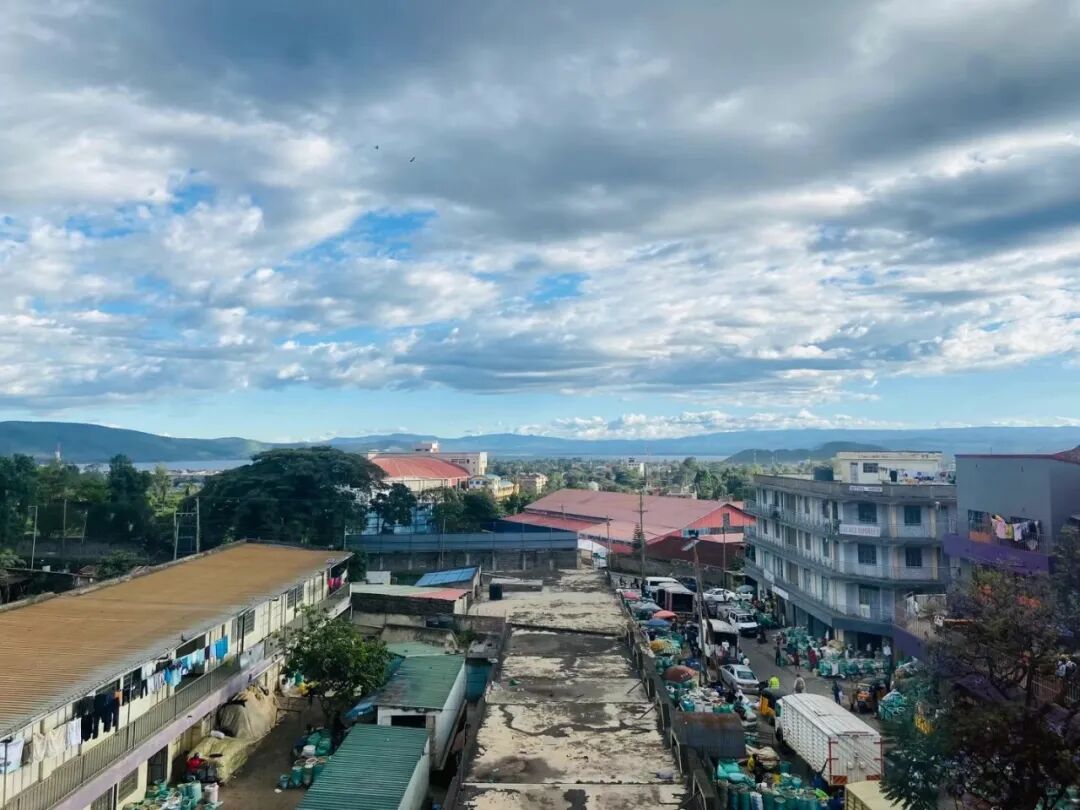 远方碧波澄明,近处一隅拥挤 (图|殳蕴钰)
Lake Nakuru and the crowded settlement nearby. Phone credit: Yunyu Shu

学者简介:
殳蕴钰现任上海财经大学经济学院资源与环境经济系助理教授。她于2025年获得布朗大学经济学博士学位。她的研究领域为发展经济学与环境经济学,聚焦发展中国家微观主体的气候适应与绿色能源转型等系列环境议题。研究覆盖中国、加纳、肯尼亚、乌干达等国家。多项主持课题获International Growth Centre (IGC)、Private Enterprise Development in Low-Income Countries (PEDL) 等国际研究机构持续资助。
做研究不易——欢迎金主爸爸来支持我们的research!
参考文献:
[1] Shu, Yunyu, and Jiayue Zhang. 2025. “Informed Climate Adaptation: Input and Output Subsidies for Shaded Cocoa.” Preprint, SSRN.
| 责任编辑 | 秦雨 |
| 整理翻译 | 何夏宇 |
| 校对 | 殳蕴钰 |